Saliency Map
-
class
olympus.dashboard.plots.saliency.GuidedBackprop(model, activation=<class 'torch.nn.modules.activation.ReLU'>, preprocessor=<function imagenet_preprocess>, postprocessor=<function imagenet_postprocessor>)[source]¶ Bases:
objectTODO: find original paper
Parameters: - model:
Pytorch model
- activation:
Type of the activation layer to use, defaults to ReLU
- preprocessor: Callable[[List[PILImage]], Tensor]
use to apply preprocessing to images
- postprocesoor: Callable[[Tensor], List[PilImage]]
used to reconstruct the image from a tensor
References
[1] J. T. Springenberg, A. Dosovitskiy, T. Brox, and M. Riedmiller. “Striving for Simplicity: The All Convolutional Net” https://arxiv.org/abs/1412.6806 [2] K. Simonyan, A. Vedaldi, A. Zisserman. “Deep Inside Convolutional Networks: Visualising Image Classification Models and Saliency Maps” https://arxiv.org/abs/1312.6034 [3] https://arxiv.org/pdf/1810.03292v1.pdf Examples
>>> import torchvision.models as models
>>> from torchvision import transforms
>>> from PIL import Image
>>> path = 'docs/_static/images/cat.jpg'
>>> img = Image.open(path)
>>> model = models.alexnet(pretrained=True)
>>> guided = GuidedBackprop(model)
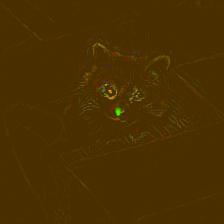
>>> _ = guided([img], [285])
>>> for i, grad in enumerate(guided.negative_saliency()):
...     img = imagenet_postprocessor(grad)
...     img.save(f'negative_saliency_{i}.jpg')

Methods
__call__(images[, classes])Parameters: activation_backward(module, grad_in, grad_out)Backward hook to the activation layer activation_forward(module, ten_in, ten_out)Forward hook to the activation layer fetch_gradient(module, grad_in, grad_out)Fetch last gradient or gradient of the first layer grad_x_input()Returns the gradient multiplied by the input image negative_saliency()Returns negative gradients positive_saliency()Returns positive gradients